
There are thriller writers—and then there are craftsmen.
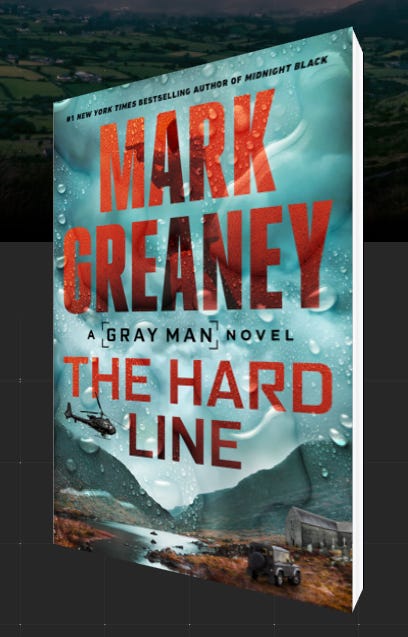
Mark Greaney belongs squarely in the latter category. With The Hard Line, the fifteenth installment in the Gray Man series, Greaney doesn’t just raise the stakes—he reframes them.
I had the opportunity to sit down with him for Episode 14 of The First Draft Podcast, and what emerged from that conversation wasn’t just a discussion about a new book. It was a window into the mindset of a writer who understands something many in the genre overlook:
The consequences of violence don’t end when the page turns.
As Greaney put it:
“What if one of the random people that Court affected or killed… wasn’t nameless and faceless… and had somebody… who could come after Court for that?”
That idea—the human cost of the “collateral characters” in action fiction—is the beating heart of The Hard Line. It’s a subtle but powerful shift. In most thrillers, the henchmen exist to be dispatched. In this story, one of them matters.
And that changes everything.
The result is a narrative that feels more grounded, more morally complex, and frankly, more honest. As I told Greaney during our conversation, the opening sequences immediately pull you into that tension:
“Your heroes aren’t always pure as the driven snow… there’s baggage.”
That’s exactly right. Court Gentry isn’t operating in a vacuum. His past actions cast long shadows—and in this case, those shadows are armed and coming for him.
Greaney leaned into that reality deliberately:
“Some of these guys are just trying to get a paycheck… and end up on the wrong side of Court Gentry.”
That line alone tells you what kind of book this is. Not just action—but reflection.
What makes Greaney particularly interesting, especially to someone with my background, is the way he approaches realism.
He doesn’t come from law enforcement or intelligence. But you wouldn’t know that from the page.
That’s not accidental.
“I’ve been training with weapons for over 20 years… you get a lot of things that you know are right… and sometimes you’re just making it up for the entertainment value.”
There’s an honesty in that answer that I respect. Because every writer in this space faces the same tension—authenticity versus responsibility.
And Greaney is fully aware of that line:
“I definitely do sometimes get things wrong just for the purpose of let’s not just make a blueprint here.”
That’s not a flaw. That’s judgment.
It’s also a reminder that the best thriller writers aren’t just storytellers—they’re curators of information. They decide what to reveal, what to obscure, and what to reshape for the sake of both realism and restraint.
We also got into process—and here, Greaney sounds like a lot of writers who have actually produced at a high level.
Not the romanticized version. The real one.
“I am a wannabe outliner… which means more of a pantser.”
There’s something reassuring about that. Fifteen Gray Man novels. Twenty-seven books overall. And still chasing the mythical “perfect outline.”
What matters isn’t the method. It’s the output.
And his discipline is clear:
“If I can get a thousand words a day, I’m a good human being… if I can get 2000 words a day, I’m a rock star.”
Every writer understands that calculus—whether they admit it or not.
One of the more interesting parts of our conversation touched on the evolution of espionage itself—and how that impacts storytelling.
In an era of mass surveillance, biometric tracking, and digital footprints, the old tradecraft is harder to sell.
Greaney didn’t hesitate:
“I think it makes it harder… I wish I was writing spy novels in 1967… with dead drops and chalk.”
And yet—even now—those old methods still linger.
That’s something I’ve seen firsthand, and it’s something Greaney captures well: the coexistence of old-school tradecraft and modern surveillance realities.
It’s not one or the other. It’s both.
What struck me most about this conversation, though, wasn’t just the technical side or even the storytelling philosophy.
It was the long view.
Greaney didn’t break through overnight. He spent years writing—quietly, persistently—before The Gray Man ever saw the light of day.
“It took me 20 years to get published… a lot of people aspire to it and never put in the work.”
That’s the difference.
Not talent. Not connections.
Work.
The Hard Line delivers exactly what you want from a Gray Man novel—tight pacing, global stakes, and relentless tension.
But it also delivers something more:
Perspective.
It asks the reader to consider the cost of the mission—not just for the hero, but for everyone in his wake.
And that’s what elevates it.
If you’re a fan of the genre, this one belongs at the top of your list.
And if you’re a writer, there’s just as much to learn from how it was built as there is to enjoy on the page.
Look for my full review at Townhall.com coming soon!
Social Media
John Nantz
X / Instagram / Facebook / LinkedIn / Truth Social: @TheJohnNantz
Mark Greaney
Website & updates: MarkGreaneyBooks.com
Grab your copy:
The Hard Line by Mark Greaney (available wherever books are sold)


