
There are conversations that feel like interviews… and then there are conversations that feel like sitting across the table from a craftsman who has spent years refining his discipline.
My discussion with Jack Carr for Episode 15 of The First Draft Podcast falls squarely into the latter category.
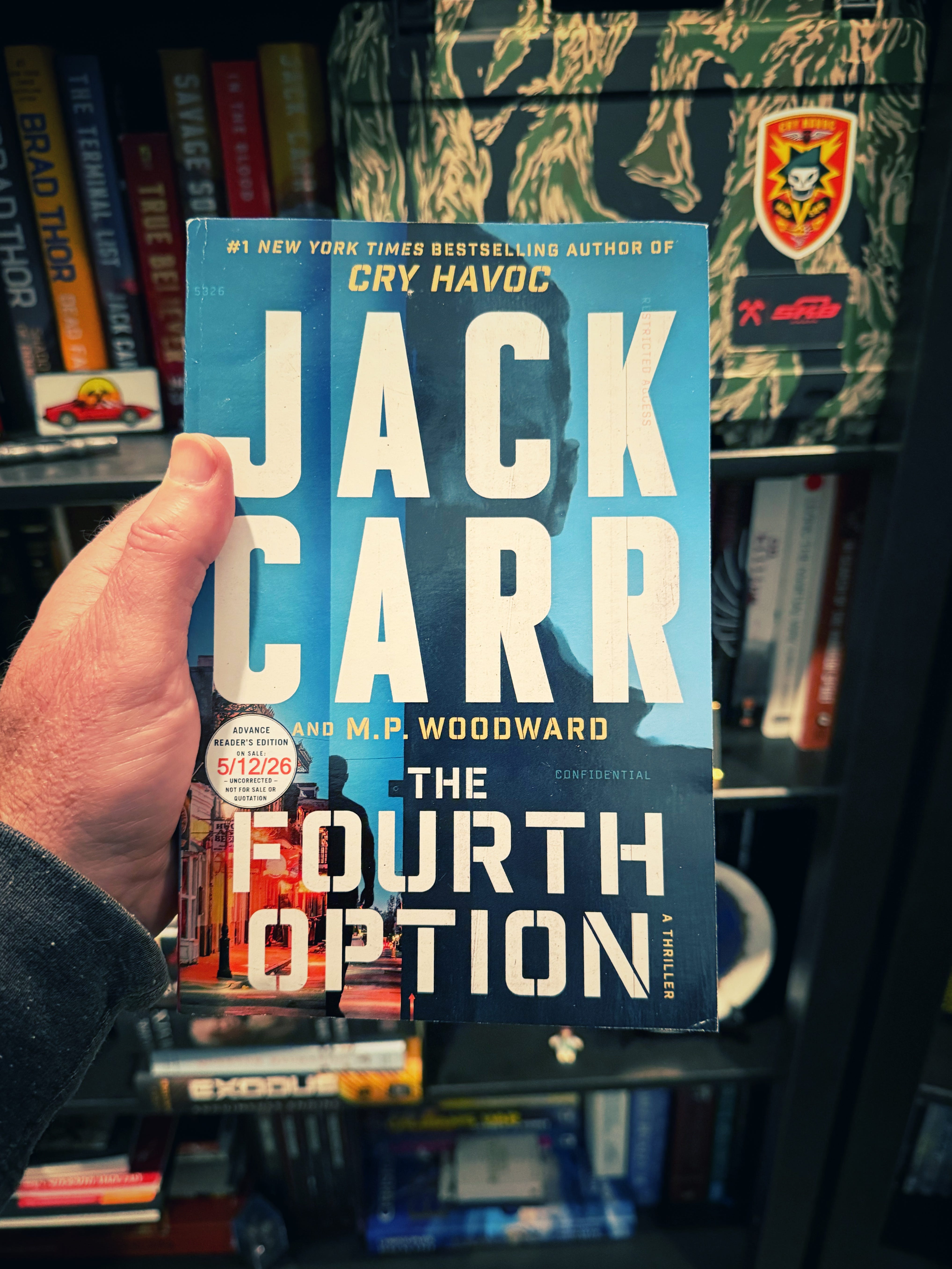
We set out to talk about his latest novel, The Fourth Option. What followed was something far more expansive—an exploration of writing as craft, storytelling as responsibility, and the enduring tension between justice and the systems meant to uphold it.
This episode is also an advance review of a book that marks the genesis of a character that resonates with me even more than Carr’s now storied and lethal James Reece.
Chris Walker is a permutation within the Jack Carr ecosystem of apex predators. A modern interpretation of the great Western gunslinger, charged by the laws of nature to bring retribution and balance to the lawless expanse of the frontier. Though the long arm of the law has long since tamed the blood red and boundless horizons of the West, the murderous spirit of Dodge City still lurks within the precincts and wards of our inner cities. Metropolises whose sighing streets long for an avenger of blood who can expunge the grief of injustices with steel wielded by a man as cold as the driven snow with no weak nerve nor fear. (Fans of Unforgiven will get that reference.)
Carr finds justice at the end of a smoking barrel with his new character Chris Walker — a complex character that embodies the spirit of the warrior poet, philosopher, and monstrous creature of war so vital to the survival of the civil society. He deals death with an existential certainty, with the impersonal and terrifying conviction of a force of nature.
Vengeance certainly belongs to God, but in the grey, Walker is a reckoning.
Walker’s infernal prey are those who are destined for the seventh circle of hell — betrayers of oath, office, and the bonds of human decency.
We meet Walker as he stares into the abyss of a cold forged barrel, nested in the distinctive bushing characteristic of a Colt 1911. His own hand grips the venerable weapon. A gun wielded by warriors since its inception. The mighty .45 caliber cartridge was born out of the necessity to destroy this planet’s most dangerous creature — man. Specifically indigenous combatants hyped up on Khat. Carried by soldiers during every Great War, and prized to this day, Walker looks to the genius of Browning to blot out his guilt in one immutable act. His 84’ Volkswagen Westfalia Vanagon is about to be his casket, bier, and tomb.
Carr gets all the details right, and develops a character of special relevance to me. FBI Agent Jarrett Stanton. Analytical right down to his Apple Watch, Stanton is representative of the ideal J. Edgar Hoover had in mind when he assembled black suit, white shirt, and black tie G-men. A facsimile copy of the Constitution occupies the place of prominence behind his desk, since his fealty is to its truths, principles, and aspirations. The character rings true of so many men and women I had the privilege to work with during my twenty year career. Carr does the men and women of the FBI a great service by not just getting the details correct about FBI minutia, but far more importantly, by capturing the spirit and dignity of the G-man as manifested not just in legend, but in the men and women of today’s FBI.
A Story That Refused to Stay on the Shelf
Carr’s newest novel didn’t begin as a book.
“The fourth option was in the lineup… and it just wouldn’t leave me.”
Originally conceived as one of several story concepts during his transition from military service, The Fourth Option lingered—persistent, unresolved, demanding attention. At one point, it was even developed into a full television treatment.
But Carr recognized something essential:
“I knew there wouldn’t be a book that someone could go to to see what was my best effort at the time… and so as soon as I got the opportunity, I clawed both those ideas back.”
That decision matters. In an era where stories are increasingly shaped for screens first, Carr deliberately chose the novel as the primary medium—the place where his “best effort” would live, unconstrained.
The Discipline of Getting It Right
One of the defining characteristics of Carr’s work—and something that came through clearly in our discussion—is his almost relentless commitment to authenticity.
“All of these are going to get my whole heart and soul into every single word. That’s what I owe that reader who’s trusting me with their time.”
That ethos is not marketing language. It’s operational.
Carr consults subject matter experts across disciplines—FBI agents, EOD technicians, K9 handlers—not to impress casual readers, but to avoid breaking immersion for those who know the world intimately.
“I don’t want to pull somebody out of the story with a mistake.”
That’s a principle I’ve seen firsthand from the law enforcement side of the house. You can get 95% of something right—but it’s the 5% that’s wrong that destroys credibility with a core audience.
Carr understands that.
The Character of the Fourth Option
At the center of the novel is a character who, in many ways, represents a departure from the James Reece archetype.
And interestingly, it’s a character I found myself relating to more.
“I want him to move… more into someone who’s an investigator… rather than that problem eliminator mindset.”
This shift is significant.
Where Reece embodies the warrior ethos, the protagonist of The Fourth Option operates in the gray space—where justice is not always delivered cleanly through institutions, and where the moral calculus becomes far more complex.
Carr frames it through a familiar escalation model:
“First option is diplomacy. Second option, overt military action. Third option, covert action… and now we have the fourth option.”
That fourth option—the one not formally acknowledged—resonates deeply with anyone who has spent time inside the system and has seen its limitations.
As I put it to him:
“Anybody that’s been in law enforcement kind of has that secret wish that they were the fourth option… because you’ve seen so much injustice… how the system doesn’t always work.”
Carr doesn’t romanticize that tension—but he doesn’t ignore it either. He leans into it.
Craft Over Formula
One of the more fascinating aspects of our conversation was Carr’s approach to character development.
It’s not formulaic. It’s not academic.
It’s organic.
“I don’t know them yet… I get to know them when I put them in conversation with somebody else.”
That approach tracks with something many writers struggle to articulate: characters aren’t built—they’re discovered.
Carr doesn’t begin with exhaustive profiles. He begins with roles, context, and conflict. The rest emerges through interaction.
“I’m getting to know them in real time… because I’m putting them in conversation.”
That method produces something readers instinctively recognize: authenticity.
Detail as Storytelling
Carr also addressed a common critique of the thriller genre—the use of technical detail.
His response reframes the issue entirely:
“Gear… tells a story… It tells me something about their level of training and competency.”
This is where some writers run the danger of overwhelming the reader. Carr, by contrast, uses detail with intent. A weapon, a vehicle, even a watch—these aren’t accessories. They’re signals.
They communicate background, mindset, and capability without exposition.
That’s not excess. That’s discipline.
The Reader in the Age of Distraction
Perhaps the most sobering part of our conversation had nothing to do with the novel itself.
It was Carr’s reflection on the modern reader.
“Readers are just dropping off a cliff… because of these devices that we carry around.”
He’s not wrong.
We are operating in an environment where long-form reading competes directly with algorithm-driven platforms engineered to fragment attention and amplify outrage.
Carr sees the consequence clearly:
“You’re developing compassion and empathy through reading… which you’re not getting as you’re being controlled by an algorithm.”
That observation goes beyond publishing. It touches on culture itself.
And it underscores why books like The Fourth Option still matter.
Final Assessment
The Fourth Option is not simply a departure from the James Reece universe—it’s an expansion.
It introduces a character operating in a different moral and professional lane. It explores justice not as a clean outcome, but as a contested space. And it does so with the same commitment to authenticity and craft that has defined Carr’s work from the beginning.
As I told him directly:
“You’ve delivered on that promise… it’s seamless… a beautifully written book.”
And that’s the truth.
Carr is not just writing thrillers. He’s elevating the genre—pushing it toward something more layered, more literary, and ultimately more enduring.
Social Media
John Nantz
X / Instagram / Facebook / LinkedIn / Truth Social: @thejohnnantz
Jack Carr
Follow for updates, releases, and behind-the-scenes content: Official Jack Carr
Buy the Book
The Fourth Option — Available May 12 wherever books are sold.


