
The Gray World of Brad Thor: Choke Point, China’s Shadow War, and 25 Years of Scott Harvath
One of the great privileges that has come from my work reviewing novels and hosting conversations on The First Draft podcast is the opportunity to develop relationships with some of the finest storytellers working today. Brad Thor is certainly among them.
Over the years, I have had the pleasure of speaking with Brad several times, and every conversation reinforces why he remains one of the premier voices in the modern political thriller genre. He is not merely a gifted storyteller. He is a serious student of history, geopolitics, intelligence, and the men and women who operate in the shadows to protect our way of life.
Before we began discussing Choke Point, Brad graciously thanked me for the time and thought I put into my reviews. That compliment meant a great deal because I have always viewed reviewing as an act of appreciation. Readers occasionally ask whether I would write a negative review. My answer has always been simple: my negative review is choosing not to write one.
Anyone who has attempted to create something—a novel, a work of scholarship, a piece of art—understands the countless hours, discipline, and emotional investment required to give an idea shape, form, and manifest it into existence. Even when I disagree with an author’s politics or worldview, I have long believed that we do ourselves a disservice when we are incapable of separating the artist from the art.
As Brad and I discussed, I may not agree with every viewpoint held by an actor, writer, or musician, but if they have created something excellent, I want to experience and appreciate the work on its own merits.
That spirit of intellectual honesty and mutual respect made our latest conversation particularly enjoyable.
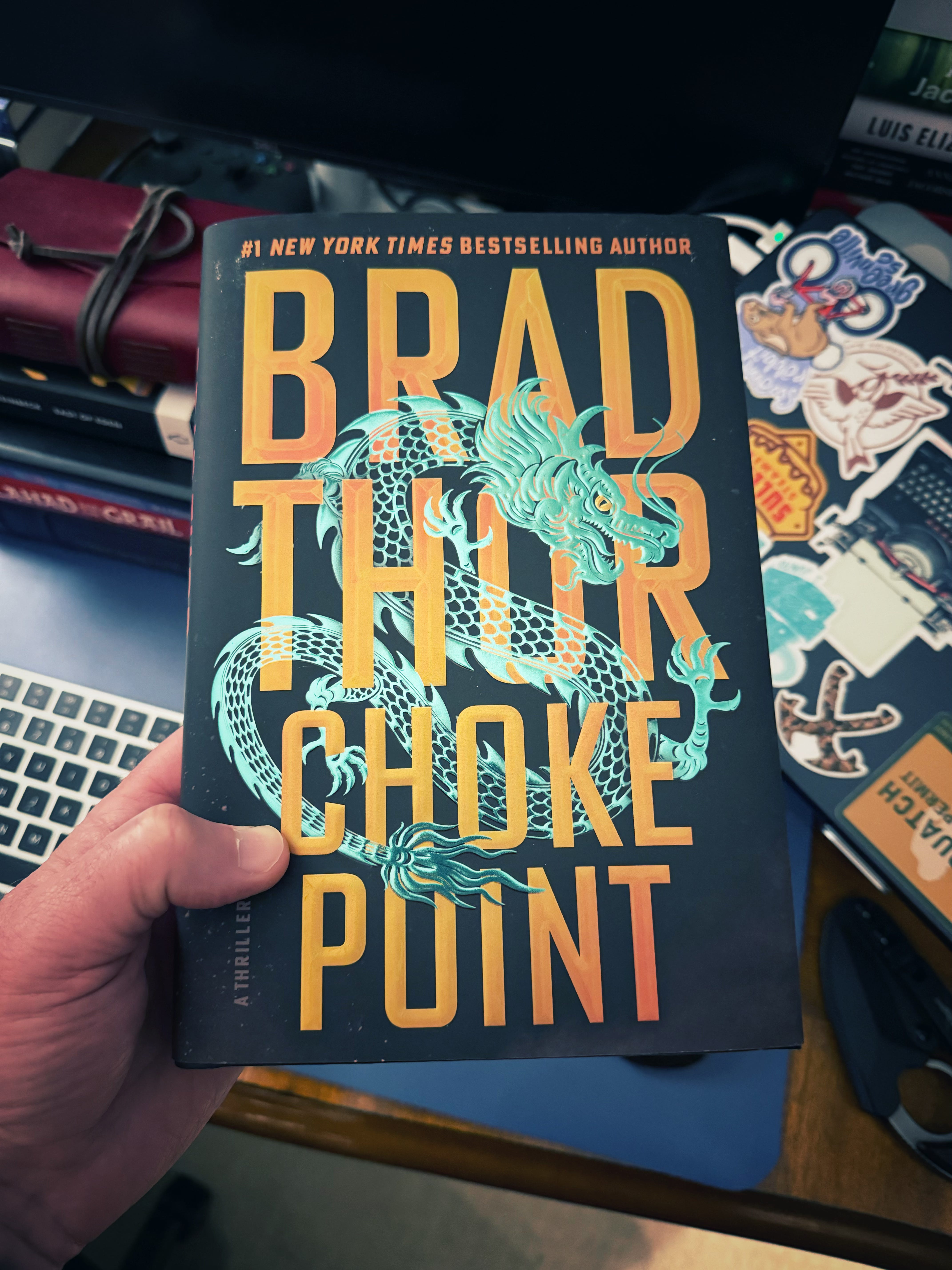
For more than two decades, and with twenty five million books sold, Brad Thor occupies a unique place in the world of political thrillers. While many authors write about espionage and geopolitics, Thor has built his reputation on something more ambitious: stories so deeply rooted in reality that readers are often left wondering where the facts end and the fiction begins.
As Thor explained:
“I call what I do faction, where you don’t know where the facts end and the fiction begins.”
That formula has produced twenty-five Scott Harvath novels, beginning with The Lions of Lucerne and continuing with his newest release, Choke Point—a novel that may be one of his most timely and thought-provoking works yet. Available everywhere 06-16-2026!
A Cover That Tells a Story
Before we ever discussed covert operations, Chinese influence campaigns, or modern intelligence warfare, I had to ask Brad about something that immediately caught my attention—the cover.
Choke Point may be one of the most visually striking entries in the Harvath series. Like Dead Fall before it, the artwork demonstrates something that publishers have always known: readers do, in fact, judge books by their covers.
The cover was created by Jimmy Iacobelli, art director at Atria Books, who works with Thor early in the creative process. For Choke Point, Thor wanted the dragon to symbolize the elite Chinese intelligence apparatus at the heart of the novel. The original concept involved a dragon formed from smoke—something dangerous, elusive, and impossible to grasp.
It is an appropriate metaphor for the invisible battles that define the modern intelligence landscape.
China’s Long Game and the Real-World Origins of Choke Point
One of the reasons the Scott Harvath series has remained so compelling is Thor’s ability to identify real geopolitical fault lines and ask the unsettling question: What if?
In this case, that question grew out of China’s long-standing interest in bypassing the Strait of Malacca, a maritime chokepoint that could be closed by the United States Navy during a conflict.
China explored the possibility of a canal through southern Thailand, but Thailand refused.
For Thor, that refusal sparked a novelist’s curiosity.
“I looked at that and thought, knowing the Chinese, I’m sure they haven’t given up.”
What followed was a classic Brad Thor thought experiment. What if China could destabilize Thailand? What if insurgency, political unrest, and regional conflict created a government more willing to advance Beijing’s strategic objectives?
And what if all of it happened without a single Chinese fingerprint being left behind?
That is the gray world of intelligence operations—the world where the most effective victories are often achieved without a shot being fired.
The Most Dangerous Enemy Is One of Our Own
One of the most fascinating aspects of Choke Point is its antagonist.
Rather than creating a one-dimensional villain, Thor crafted a former American warrior—an explosive ordnance disposal specialist who entered the SEAL Teams through a very real military pathway and eventually became one of the most dangerous men in the world.
His downfall is rooted in a loss of identity after being cast out of the community that defined him.
The result is a villain who is terrifying not because he is purely evil, but because he is understandable.
As Thor explained:
“Now Harvath is hunting essentially one of our own.”
It is a brilliant narrative choice because the adversary possesses many of the same skills, training, and mindset as the hero pursuing him.
The best villains are often those whose pain we can understand, even when we reject the choices they make.
The New Battlefield Is the Human Mind
As a retired FBI counterintelligence professional, this portion of our discussion was especially meaningful to me.
Too many Americans still imagine intelligence operations through the lens of the Cold War—dead drops, coded messages, and shadowy figures exchanging briefcases in dark alleys.
Today’s battlefield is often a smartphone.
Foreign adversaries understand that they do not necessarily need to defeat America militarily. They can weaken America by amplifying division, eroding trust, and manipulating citizens into believing ideas that were carefully planted by hostile actors.
Thor offered a particularly important warning:
“Our enemies want to create disunity.”
He also described our tendency toward poor “digital hygiene,” especially in online communities where we believe we are surrounded by like-minded people and therefore lower our guard.
The greatest intelligence operations are often the ones in which the target never realizes he has been manipulated.
That reality makes stories like Choke Point more than entertainment. They serve as reminders of the world as it actually exists.
“They’re the Best. If Anyone Can Get to the Bottom of This, It’s the Bureau.”
As a retired FBI Supervisory Special Agent, I would be remiss if I did not mention one particular line in Choke Point that made me smile.
When Scott Harvath is confronted with a complex investigation, he speaks about the FBI’s Evidence Response Team and says:
“They’re the best. If anyone can get to the bottom of this, it’s the Bureau.”
The FBI has endured controversy and criticism in recent years. Some of that criticism has been deserved. Some has been exaggerated. But what remains unchanged is the extraordinary work performed every day by thousands of agents, intelligence analysts, professional staff, and specialists who dedicate their lives to protecting the American people.
Brad’s response reflected his long familiarity with the Bureau:
“It’s a tremendous organization that has done so much good for our country.”
He continued:
“I’ve always admired the standard that the FBI holds itself to.”
No institution composed of human beings will ever be perfect. But the measure of an institution is not whether individuals occasionally fail to meet the standard—it is whether the institution maintains a standard worthy of striving toward.
The FBI at its best has always represented that ideal.
What Scott Harvath Taught His Creator
I asked Brad what twenty-five novels had taught him about Scott Harvath—what he understood about the character now that he did not know when he wrote The Lions of Lucerne.
His answer was perhaps the most profound moment of our conversation.
“There is no American dream without those willing to protect it.”
That statement captures the essence of the entire Harvath series.
The freedoms we enjoy do not exist by accident. They endure because soldiers, intelligence officers, law enforcement professionals, diplomats, and countless others quietly accept burdens most Americans will never see.
Harvath is fictional.
The men and women he represents are not.
From Page to Screen: The Future of Cold Zero
We also discussed the long-awaited adaptation of Cold Zero, one of my personal favorites in the Harvath series.
Thor shared that screenwriter Nic Pizzolatto, creator of True Detective and writer of The Magnificent Seven adaptation, is actively working on the screenplay. The goal, according to Thor, is not merely to create another spy film, but something larger in scope—a modern thriller in the spirit of The Hunt for Red October.
As a longtime reader of the series, that is exciting news.
Too often, beloved novels lose something in the transition to the screen. But Thor offered a thoughtful perspective on adaptation: the book and the film are different artistic mediums, and the key is partnering with filmmakers who understand both the original story and the demands of cinema.
If the adaptation captures the authenticity, tension, and scale of Cold Zero, audiences are in for something special.
Final Thoughts
Twenty-five books into the Scott Harvath series, Brad Thor continues to accomplish something rare.
He entertains.
He educates.
And he reminds readers that beneath the headlines of our daily lives, there exists a complex world of intelligence, diplomacy, military power, and individuals who willingly step into danger so that others may live in peace.
Choke Point is another exceptional entry into the Harvath universe—a fast-paced, meticulously researched thriller that feels less like an escape from reality and more like a warning about where reality may be headed.
Twenty-five novels later, Scott Harvath remains one of the most compelling figures in modern thriller fiction.
After speaking once again with the man who created him, it is easy to understand why.
Look for my full review of Choke Point at Townhall.com!
Connect with Brad Thor
Official Website:
BradThor.com
Follow Brad on Social Media:
Instagram: @realbradthor
Threads: @realbradthor
Purchase Choke Point:
Order the latest Scott Harvath thriller directly from Brad’s official book page:
Choke Point by Brad Thor


