
A Green Beret Goes Hunting for the Atlantis of the Sands
Alex Dekker’s Desert Heist combines Special Forces authenticity, ancient history, and old-fashioned adventure to introduce one of the most promising new voices in thriller fiction.
Every so often, a debut novel lands on my desk that makes me wonder where the author has been hiding. Alex Dekker’s Desert Heist is one of those books.
I recently had the opportunity to interview Dekker after reading his debut thriller, and I told him something I don’t say lightly: his writing belongs in the same conversation with some of the best writers working in the thriller genre today. Comparisons to Brad Thor, Jack Carr, and other established names are inevitable, particularly given Dekker’s background. But after finishing Desert Heist, I think those comparisons may actually undersell what he has accomplished.
Dekker has created something that stands very much on its own.
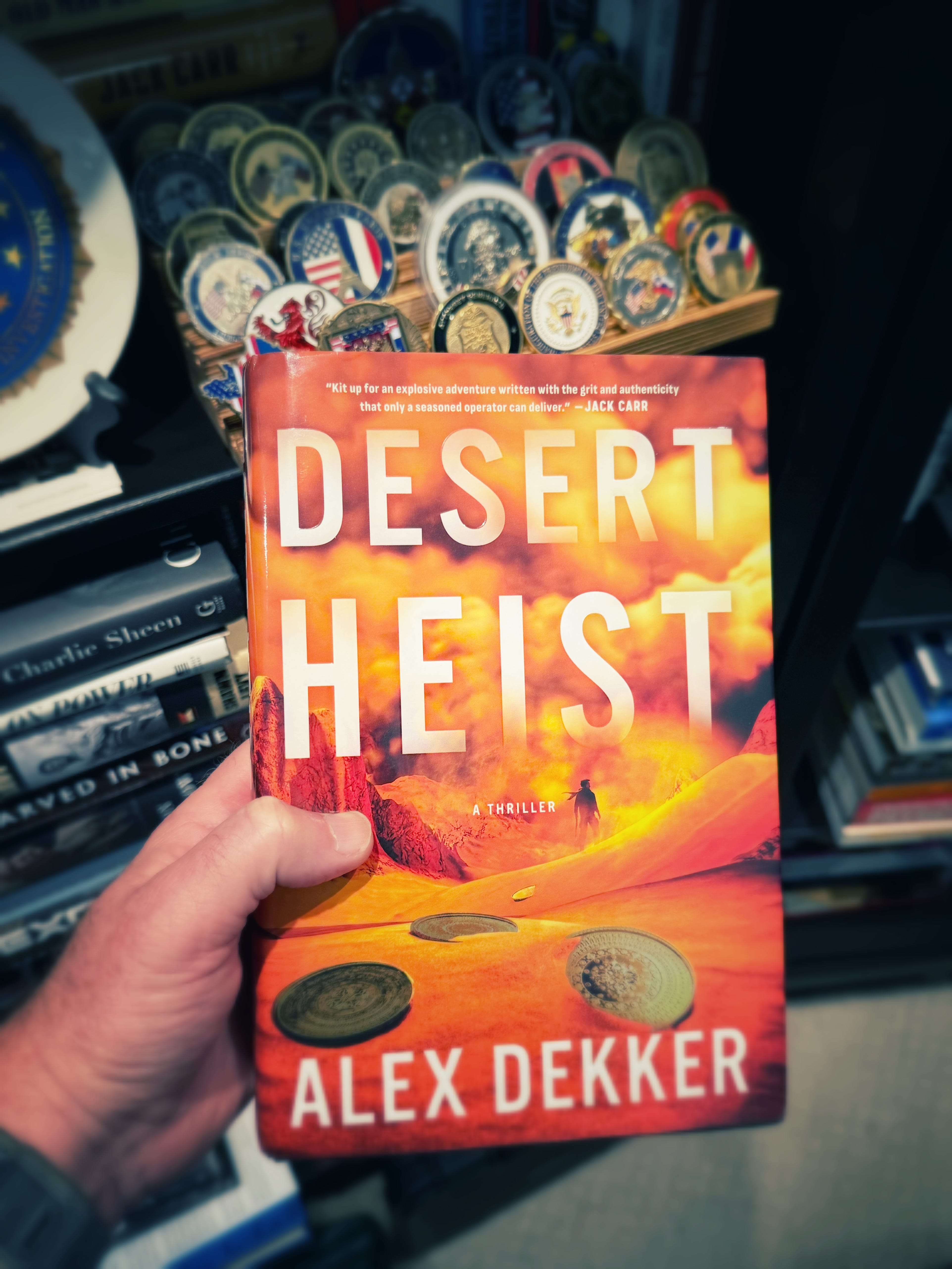
Desert Heist is part military thriller, part archaeological mystery, and part old-fashioned adventure story. Imagine taking the military authenticity readers expect from Thor or Carr, mixing it with the historical mysteries of Clive Cussler and Dan Brown, and adding a healthy dose of Indiana Jones. That gets you somewhere in the vicinity of what Dekker is doing.
But the formula works because the man writing it has actually lived in both worlds.
Dekker spent nearly twenty years in Army Special Forces, including service with the legendary 5th Special Forces Group and extensive time operating throughout the Middle East. He served as a Special Forces Intelligence Sergeant, speaks Arabic, and deployed repeatedly into places most Americans will experience only through television screens and newspaper headlines. At the same time, he possesses a lifelong fascination with history and archaeology.
Those two worlds converge in Nate Wilde.
Wilde is a former Green Beret who leaves the military to pursue archaeology and becomes obsessed with the legendary lost city of Ubar—the so-called “Atlantis of the Sands.” When the academic establishment rejects his proposal and the conventional avenues of exploration disappear, Wilde turns to the people he trusts most: his former Special Forces brothers. Soon they are moving through Yemen and into Saudi Arabia’s Empty Quarter in search of a mystery buried beneath the desert.
Naturally, other people are looking for it too.
What follows is a fast-moving adventure involving terrorists, a dangerous former Spetsnaz operative, ancient mysteries, modern geopolitics, and a discovery with potentially enormous implications. But what separates Desert Heist from the crowded military-thriller field is not the gunfights. It’s authenticity.
During our conversation, Dekker explained that the legend of Ubar was something he encountered through his years in the Middle East. Also known as Iram of the Pillars, the legend appears in Middle Eastern tradition, including the Quran and One Thousand and One Nights. Dekker had been fascinated by the story for years. When he began thinking about writing an Indiana Jones-style adventure grounded in historical fact and military realism, the Middle East was the natural setting—and Ubar became the natural mystery around which to build it.
That approach permeates the novel.
Dekker told me that one of his influences was Dan Brown’s The Da Vinci Code, particularly the sensation of reading the story and wondering where historical fact ended and fiction began. Dekker wanted to reproduce that experience. His goal was to ground Desert Heist in enough legitimate history that curious readers could stop, search for something they encountered in the novel, and discover that the historical thread was real. That may be one of my favorite things about this book.
I knew very little about Ubar before reading Desert Heist. The novel made me want to know more. A good historical thriller entertains you. A very good one sends you down rabbit holes after you close the book. Dekker understands that distinction.
He also understands something else that is exceedingly difficult to fake: combat.
During his Special Forces career, Dekker was seriously wounded in a Taliban grenade attack in Afghanistan. He and the other Americans in his element, along with Afghan partners, were caught in an ambush and had to fight their way out before eventually being medically evacuated.
When I asked whether experiences like that affected the way he writes combat, his answer helped explain why the action in Desert Heist feels different. It isn’t imagined or derived solely from research.
Dekker described another incident in Iraq involving a fuel tanker used as a vehicle-borne improvised explosive device. The blast knocked him off his feet. He remembers the sound, the fireball, the physical sensation and the disorientation. Elements of that experience eventually found their way into Desert Heist.
Readers with military and law-enforcement backgrounds immediately recognize when an author doesn’t understand weapons, tactics, violence, or how trained people behave under stress. One glaring mistake can pull an informed reader completely out of a story. I found nothing like that in Desert Heist.
But perhaps even more interesting is that Dekker applies the same standard to archaeology.
He told me he consulted archaeologists while developing the novel—not merely about historical facts, but about what archaeologists actually do on the ground, how excavations and expeditions work, how documents are handled, and even what the academic process looks like. His objective was simple: he didn’t want the archaeologist reading Desert Heist pulled out of the story any more than he wanted the Green Beret pulled out of it.
That attention to detail shows.
Yet for all the action, history, weapons, ancient mysteries, and exotic locations, I came away from my conversation with Dekker believing that another theme may ultimately be the heart of this series.
Brotherhood.
Nate Wilde and the men around him are not simply former operators assembled because Dekker needed a capable team for an adventure. They are men who once belonged to something extraordinarily close and then lost it.
Dekker explained that a twelve-man Special Forces Operational Detachment Alpha becomes something resembling a second family. The men live together, train together, fight together, sleep in the same tents, share stories, and sometimes face death together. Over time, the team develops what Dekker described as almost a collective personality. Then one day it’s gone.
The operator retires or leaves the military and discovers that civilian life cannot completely replicate what he left behind. That experience informs the characters in Desert Heist. These men aren’t simply searching for Ubar. In different ways, they are searching for something missing in themselves.
Dekker pointed to a quiet scene between Nate and Tim aboard a boat as one of the portions of the novel he particularly enjoyed writing. It isn’t a firefight. There is no archaeological revelation. It’s simply two men who have experienced a great deal together attempting to close the distance that has grown between them.
Those moments give Desert Heist considerably more depth than its premise might initially suggest. There is also something refreshing about Dekker’s prose. It’s clean.
That was the word I used during our interview, and I think it’s still the best description. The writing is tight, the pacing is excellent, and Dekker doesn’t clutter his narrative with unnecessary exposition designed to demonstrate how much he knows. The military experience is there. The archaeology is there. The history is there. But all of it serves the story rather than overwhelming it.
That’s especially impressive considering this is a debut.
Even more remarkable, Dekker told me he wrote the initial draft in roughly three months.
When I jokingly asked him which was harder—the Special Forces Qualification Course or writing Desert Heist—there wasn’t much hesitation.
The Q Course.
Writing, he said, came naturally.
In fact, his bigger problem is apparently stopping. Dekker described writing five or ten thousand words before looking at the clock and realizing it was three in the morning.
Dekker has already completed the second Nate Wilde novel and was working on the third when we spoke. He told me he has ideas for approximately fifteen more books, generated in part by the historical rabbit holes he routinely explores.
“The adventures of Nate Wilde will continue as long as people are interested in reading them,” he told me.
There is a tendency whenever a new military thriller writer arrives to ask whether he might be “the next” Brad Thor, Jack Carr, Vince Flynn, or whoever happens to occupy the appropriate place on the bookshelf. I understand the impulse.
But I’m increasingly convinced it’s the wrong question to ask about Alex Dekker.
The better question is whether readers will eventually be comparing new authors to him. Desert Heist is that good.
It is an extraordinarily confident debut: intelligent without becoming academic, authentic without becoming technical, and fast-paced without sacrificing character. It takes readers somewhere unfamiliar, introduces them to a genuine historical mystery, and surrounds that mystery with characters worth following.
Most importantly, it’s fun.
Dekker told me that when readers finish the novel, he wants them to feel as though they went on an adventure with these characters and enjoyed the time they spent there.
Mission accomplished.
Desert Heist isn’t merely an impressive first novel. It is the beginning of what I suspect will be a very successful series—and the arrival of an author thriller readers are going to be hearing about for a long time.
Highly recommended.
Desert Heist by Alex Dekker is published by Emily Bestler Books/Atria Books, an imprint of Simon & Schuster.
About Alex Dekker
Alex Dekker served for nearly twenty years in the U.S. Army Special Forces, first with the 5th Special Forces Group and later with the U.S. Army Special Operations Command. A veteran of multiple deployments to Iraq, Afghanistan, and other locations around the world, Dekker is also an Arabic speaker, student of history, and participant in archaeological digs. He holds a master’s degree in Applied Intelligence from Georgetown University. Desert Heist is his debut novel and the first installment in the Nate Wilde series.
Connect with Alex Dekker:
Website: AlexDekkerOfficial.com
Instagram: @alxdekker
X: @alxdekker
Facebook: Alex Dekker
TikTok: @alexdekkerofficial
Desert Heist is published by Emily Bestler Books/Atria Books, an imprint of Simon & Schuster.


